
The Incident Command System: Bring Clarity and Control to Cyber Incident Response
Why Cyber Incidents Need Structure
Confusion often spreads faster than the attack itself when a serious cyber incident unfolds. Systems are failing, executives are demanding updates, and technical teams are working around the clock. In the middle of that storm, the most valuable thing you can have is structure.
The Incident Command System (ICS) is a proven framework originally designed for emergency services managing wildfires, natural disasters, and large-scale crises. It provides a scalable model for command, control, and coordination, and a way to bring order to chaos.
While ICS has its roots in physical emergency response, its principles translate perfectly to cyber incidents. It creates a common language for decision-making, defines clear roles and responsibilities, and ensures everyone knows who’s in charge of what. Especially for organisations without a full-time Security Operations Centre (SOC), this structure can make the difference between a controlled response and a fragmented, uncontrolled escalation.
Every major incident, from data breaches to ransomware, tests how well an organisation can coordinate under pressure. In the absence of structure, even the most skilled teams can pull in different directions.
For regulated and high-consequence organisations, the challenge during a cyber incident is rarely just technical containment; it’s coordinating decision-making, communications, legal obligations, and operational response under pressure.
That’s why structure matters. A clear command model helps organisations demonstrate that incident response isn’t improvised, but managed in a controlled, repeatable way.
Need a clearer picture of how your organisation would coordinate during a serious incident?
If you’re unsure whether your current response structure, decision-making, and escalation paths would hold up under pressure, explore our Incident Capability Validation. It’s a structured assessment designed to baseline and stress-test your organisation’s incident response capability.
Imagine this: your organisation discovers that an HR database containing employee information has been breached. IT staff start shutting down systems to contain the incident, while the communications team drafts a public statement based on incomplete information. Legal counsel begins reviewing privacy legislation for mandatory reporting, and HR starts fielding calls from concerned employees. Each team acts with good intentions, but without a defined command structure, efforts overlap, decisions conflict, and time is lost.
Without a defined command structure, the organisation risks making technically reasonable decisions in the wrong order, with inconsistent messaging and avoidable delays.
This kind of duplication and confusion is common in unstructured IR. Frameworks like the NIST Cybersecurity Framework (CSF) and SANS PICERL all recognise the need for clear command and communication principles, but they often stop short of describing how to achieve them. That’s where the Incident Command System steps in.
ICS provides the operational discipline needed to translate those frameworks into action. It defines who leads, who decides, and who communicates, ensuring that every team contributes to a coordinated response rather than a chaotic one.
Understanding the Incident Command System
At its core, ICS is a command and control structure built on clear roles, defined authority, and consistent communication. It’s scalable, meaning the same principles can apply whether you’re managing a small phishing incident or a nationwide data breach.
Here’s how it works:
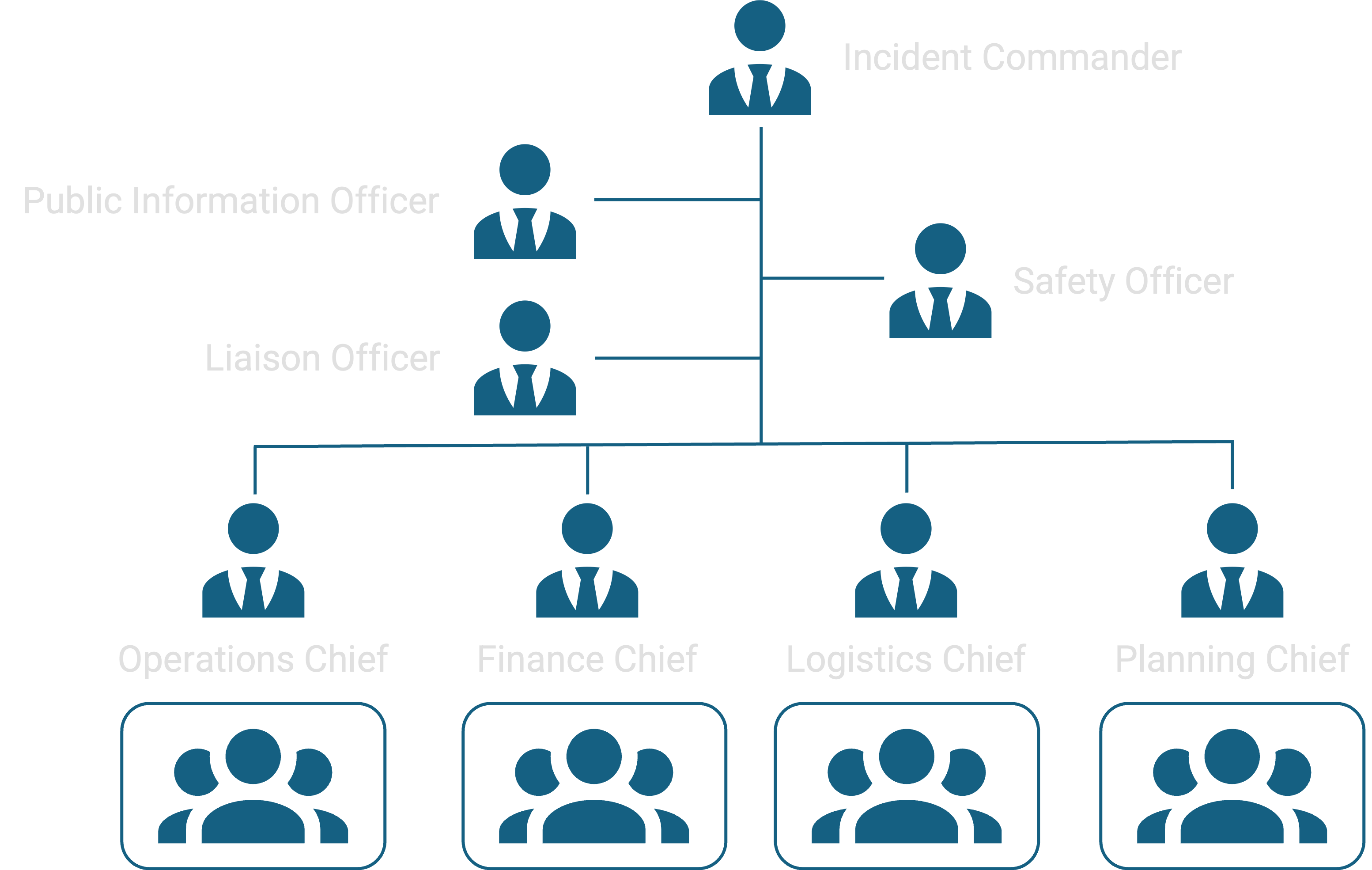
- Incident Commander (IC): The single point of overall authority. The IC sets objectives, approves key decisions, and ensures alignment between technical and business priorities
- Operations: The team that does the hands-on work: containment, eradication, recovery, and restoration. In a cyber context, this typically includes IT administrators, network defenders, and security analysts
- Planning: Responsible for gathering information, maintaining situational awareness, and anticipating what comes next. This team tracks incident status, maintains logs, and supports decision-making with facts
- Logistics: Ensures people, systems, and resources are available when needed. That could mean securing additional cloud resources, arranging external specialists, or managing internal access permissions
- Finance / Administration: Handles approvals, budgets, contracts, and documentation of costs. In regulated environments, this role also ensures compliance with record-keeping and reporting obligations
- Public Information Officer (PIO) and Liaison Officer (LO): Optional in smaller incidents, these roles coordinate external communications and stakeholder engagement, such as regulators, partners, or customers
Applying ICS to Cybersecurity
This model translates to the digital world surprisingly well.
In a typical cyber incident response, the mapping looks like this:
- The CISO or IR Lead serves as the Incident Commander, responsible for overall coordination and decision-making
- The technical response team (security analysts, network engineers, and system administrators) form Operations, executing containment, eradication, and recovery steps
- The comms and legal teams handle external coordination, acting as the Public Information Officer and Liaison Officer, managing communication with the media, customers, and regulators
- HR and administrative staff may fill Logistics and Finance functions, ensuring the right people are available, costs are approved, and records are properly kept
In practice, the model clarifies three questions that often derail cyber response:
Who makes decisions?
- The Incident Commander does, informed by input from the other sections
Who communicates externally?
- Only the authorised Public Information or Liaison Officer, ensuring messages are accurate and consistent
Who documents actions and progress?
- The Planning section, maintaining a real-time understanding of what has been done and what remains
This clarity is especially important when incidents trigger legal, regulatory, or executive reporting obligations, where confusion over authority can create as much risk as the technical incident itself.
Benefits of Using ICS in Cyber Response
Adopting ICS principles brings tangible benefits.
Clear authority and accountability: Everyone knows who’s in charge, what their role is, and how decisions are made, reducing friction and eliminating confusion during high-stress moments.
Streamlined communication: ICS provides a common language across technical and business teams. Instead of parallel conversations, updates follow a structured briefing format at a regular cadence, keeping everyone aligned.
Seamless coordination with external partners: When working with law enforcement, regulators, or external IR firms, ICS offers a familiar structure. Most emergency management and critical infrastructure organisations already recognise this model.
Consistency in exercises and real events: Once implemented, the same command structure can be used for TTXs, simulations, and actual incidents, helping your teams build muscle memory.
Scalability and flexibility: Whether it’s a small malware outbreak or a major data breach, ICS scales up or down without losing clarity.
Want to see whether your current command structure works in practice?
Our Cybersecurity Tabletop Exercises help teams rehearse decision-making, escalation, and communications under realistic incident conditions.
How to Implement ICS in Your IR Program
Transitioning to an ICS-based model doesn’t require a massive overhaul. In most organisations, it means formalising decision authority, communication pathways, and role clarity so they hold up during real incidents as well as exercises.
Step 1: Define and document ICS roles within your Incident Response Plan
Review your existing IRP and identify where the ICS roles fit. Assign ownership of Incident Commander, Operations, Planning, Logistics, and Finance functions.
Step 2: Assign primary and alternate staff for each role
Cyber incidents can happen at any time, and frequently span multiple days or weeks. Make sure each role has at least one backup to maintain continuity if someone is unavailable or needs to rest. Where possible assign roles to positions, titles, or teams rather than individuals who might change roles, go on annual leave, or otherwise become unavailable.
Step 3: Train those stakeholders on their responsibilities
Run short briefings or workshops explaining how ICS works and what each role is expected to do. Focus on decision authority and communication flow rather than technical details at this stage.
Step 4: Incorporate ICS terminology into playbooks and exercises
When running TTXs, use ICS roles by name. For example, having updates reported to the Incident Commander rather than “the IR Lead” reinforces consistent language and expectations, because the way you practice is the way you perform.
Step 5: Test and refine the structure
During tabletop or simulation exercises, observe how your ICS structure functions. Identify where communication breaks down, who gets overloaded, and where responsibilities overlap. Then, refine your plan.
By taking these steps, you turn the ICS model from a concept into a living framework that supports both preparation and real-world execution.
Developing a RACI to Support ICS Roles
Once ICS roles are defined, the next step is to make responsibilities crystal clear. That’s where a RACI matrix comes in.
A RACI (Responsible, Accountable, Consulted, Informed) chart complements ICS by translating broad role definitions into specific actions. It removes ambiguity over who does what during each stage of an incident.
For the uninitiated:
- Responsible: The person or team doing the work
- Accountable: The person ultimately answerable for the outcome
- Consulted: Those who provide input or expertise
- Informed: Those who need updates or awareness but aren’t directly involved
Start by listing your key IR activities like detect incident, contain threat, notify regulators, restore systems, and conduct post-incident review. Then, map those activities against your ICS roles.
Here’s a brief example of what that might look like:
| Activity | IC | Ops | Planning | Logistics | Fin/Admin | Legal | Comms |
|---|---|---|---|---|---|---|---|
| Detect | I | R | A | I | I | I | I |
| Contain | A | R | C | I | I | I | I |
| Notify Regulator | A | C | C | I | I | R | R |
| Restore | A | R | C | C | I | I | I |
| PIR | A | C | R | C | I | C | I |
| Legend: R = Responsible, A = Accountable, C = Consulted, I = Informed | |||||||
In smaller teams, individuals may appear in multiple columns; for instance, your CISO might act as both Incident Commander and Planning lead. That’s fine. The goal is not to assign more people but to create shared understanding.
A RACI is also a valuable training and exercise tool. It helps new team members quickly understand their role during a crisis and ensures no critical activity is left without ownership. Review it annually, alongside your IR plan and playbooks, to reflect personnel or process changes.
Best Practices
Keep it simple. For smaller organisations, you may only need three or four defined roles. Avoid over-engineering the structure. Use familiar titles where helpful. If “Incident Commander” feels too formal, “IR Lead” or “Response Coordinator” can work just as well, provided the decision authority is clear. The function matters more than the name. Understand as well that any third party (like your IR provider, vendor, outsourced SOC or MSSP) will likely have a similar structure on their side of the fence; ensure both sides know who to call.
Empower the Incident Commander. This person must be able to make real-time decisions without waiting for multiple approvals. That empowerment is critical during containment and recovery. Maintain updated contact lists and succession plans. A well-defined chain of command only works if you can reach the right people when it matters. After each exercise or real incident, conduct a structured review (lessons learned exercise or post-incident review). Assess how well the command structure worked, what information flowed smoothly, and where bottlenecks occurred. Then, capture those lessons in your IRP and playbooks.
Exercise the structure, not just the scenario. Use the same command roles and briefing cadence in tabletop exercises that you expect teams to use during real incidents. This is how structure becomes habit.
Turning Structure into Capability
The Incident Command System brings order to the chaos of cyber incidents. It transforms an IR plan from a static document into a practical command framework that aligns people, decisions, and communications when pressure is at its highest.
For mid-sized and regulated organisations, adopting ICS doesn’t mean adding bureaucracy. It means creating a simple, repeatable structure for managing incidents with confidence.
Start small: identify who your Incident Commander would be today, assign the supporting roles, and use that structure in your next tabletop exercise.
If you want a quick way to assess whether your current plans and playbooks support a coordinated response, begin with our Incident Response Plan & Playbooks: 10-Minute Quality Check.
If you want to rehearse coordination, decision-making, and communications under realistic conditions, explore our Cybersecurity Tabletop Exercises.
And if you want a structured assessment of your organisation’s broader incident response capability, see our Incident Capability Validation.
The goal isn’t to make incidents feel more formal. It’s to make the organisation more controlled, more coordinated, and more effective when it matters most.
Disclaimer: This content may have been edited or refined with assistance from AI tools. All final content, views, and recommendations are our own.